
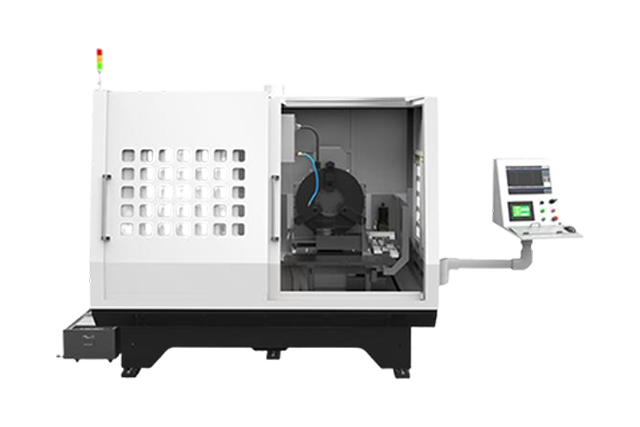
1. What Is a Silicon Wafer Cutting Machine?
A silicon wafer cutting machine cuts silicon ingots into thin slices called wafers. Manufacturers usually produce these wafers for semiconductor and photovoltaic applications.
Diamond wire dominates as the cutting medium in modern equipment. As a result, manufacturers can achieve narrow kerf while maintaining efficient material use.
The wafer cutting machine moves the thin wire across the silicon crystal. In tandem, the precision feeding system advances the silicon into the cutting area.
Diamond abrasives grind away silicon along the cutting trajectory. Gradually, the silicon transforms into thin slices.
Wafer slicing requires much more control than simply separating material. For example, manufacturers must regulate thickness, TTV, bow, warp, surface quality, and kerf loss.
The result is that machine accuracy directly impacts wafer quality further down the production line. Precision motion control and automated processing combine in a modern silicon wafer cutting machine.
Servo systems allow manufacturers to maintain stable wire oscillation and workpiece feeding. These features allow manufacturers to use the equipment to produce wafers consistently in industrial production settings.
2. How Does a Silicon Wafer Cutting Machine Work?
Operators use high-speed wire movement to slice wafers from a silicon ingot. The following steps illustrate the basic slicing process:
- Prepare and mount the silicon crystal ingot.
- Apply tension to the cutting wire.
- Accelerate the wire to operating speed.
- Feed the silicon wafer into the cutting wire.
- Diamond abrasives remove silicon from the cutting zone.
- Cutting fluid regulates temperature and removes debris.
- Repeat steps 3-6 until finished.
Multi-wire equipment includes many parallel wire loops that work simultaneously. Manufacturers can produce numerous wafer slices in one slicing cycle with these systems.
Multi-wire technology suits industrial wafer slicing due to this principle.
In addition to mechanical processes, automated controls monitor key operating parameters. Parameters may include wire speed, tension, feed speed, and wire positioning.
Operators can achieve better overall process control as a result.
3. Why Silicon Wafer Cutting Requires High Precision
Semiconductor manufacturers build many electronic processes around silicon wafers. Dimensional accuracy therefore becomes a critical consideration.
Small deviations in slicing introduce greater work later in the production process. For instance, higher thickness variation creates a need for more grinding.
Similarly, surface defects from cutting increase polishing efforts. Additionally, large kerf wastes usable silicon.
Manufacturers must balance many different production targets as a result.
Manufacturers want high throughput without sacrificing wafer geometry. Additionally, thin wire can reduce kerf, although excessive thinning increases breakage risks.
At the same time, controlled feeding helps prevent unnecessary surface damage. For these reasons, a silicon wafer cutting machine requires precise motion and wire tension control.
Machine and structural rigidity also become important considerations.
Movement can disrupt wire motion and cutting precision. A rigid machine structure can provide better wafer quality as a result.
4. Main Components of a Silicon Wafer Cutting Machine
Designers lay out several key systems on modern silicon slicing equipment.
4.1 Diamond Cutting Wire
The cutting wire makes the direct contact necessary for material removal. Tiny diamond abrasive particles allow the wire to cut through hard silicon.
Smaller diameters can also help decrease kerf. However, very thin wire demands exact tension control.
4.2 Wire Drive System
The drive system determines wire motion across the cutting surface.
Stable motor performance ensures consistent cutting environments. Many modern machines utilize servo technology for this exact reason.
4.3 Wire Guide System
Guide elements define the cutting wire’s path.
Guide precision therefore affects wafer geometry and cutting accuracy. Multi-wire machines use guide rollers to create numerous cutting sections parallel to one another.
4.4 Tension Control System
Wire tension has a strong effect on slicing results.
Too little tension introduces instability. However, too much tension puts additional stress on the wire.
As a result, the tension control system needs to keep tension within an optimal range.
4.5 Workpiece Feeding System
The feeding mechanism determines how silicon enters the cutting wire.
Precise control over feed speed allows for stable material removal. Moreover, servo feeding allows adjustment for optimal speeds at different stages of cutting.
4.6 Cutting Fluid System
Heat and silicon debris accumulate in the cutting zone.
A cutting fluid circulating through the cutting area can mitigate these conditions. Filtration also plays a role by removing contaminants from the circulating fluid.
4.7 PLC and HMI
Programmable logic controllers (PLCs) automate modern silicon wafer cutting machines.
Operators can input recipes for slicing different types of silicon. Moreover, the HMI may show users operating conditions and alerts.
5. Silicon Wafer Cutting Process
Silicon wafer production follows several distinct stages. The steps below outline a typical slicing process:
Step 1: Silicon Ingot Preparation
Manufacturers first prepare the monocrystalline/polycrystalline silicon ingot for cutting. The size of the ingot depends on what wafer size the producer needs to make.
Step 2: Ingot Positioning
The operator then mounts the workpiece onto the fixture. Correct orientation ensures the cutting machine maintains proper crystal direction.
Step 3: Wire Installation
The operator installs and configures the diamond wire system. Then the machine moves the wire to its cutting path at proper tension.
Step 4: Parameter Programming
The slicing recipe gets the operator’s configuration at this stage. Typical slicing parameters include wire speed, tension, feed rate, and cooling requirements.
Step 5: Cutting
Now the machine begins wire motion at set speeds. At the same time, the silicon gradually feeds through the web of wire. Diamond abrasives continually remove silicon from the ingot.
Step 6: Cooling and Filtration
A coolant removes excess heat and silicon debris from the cutting area.
Stable circulation allows the cutting process to continue at a consistent rate.
Step 7: Wafer Separation
Operators separate the wafer slices from each other following cutting. These individual wafers still require further processing at this stage.
Step 8: Downstream Processing
Wafers move through grinding, lapping, polishing, cleaning, and inspection processes. As such, cutting represents the start of the journey, not the end.
6. Diamond Wire Cutting Technology
Diamond wire plays a prominent role in today’s silicon wafer cutting machines.
Diamond particles embed along the working surface of the wire. During contact, the wire removes silicon from the ingot.
Diamond wire offers several benefits to silicon wafer slicing. First, manufacturers achieve relatively narrow kerf widths.
Narrower kerf allows manufacturers to use more of the silicon ingot. Second, diamond ranks among the hardest materials.
The hardness allows the wire to cut through silicon with ease. Third, higher-speed automated equipment exists for diamond wire cutting machines.
High speeds enable industrial-scale silicon wafer manufacturing with diamond wire. Wire quality alone does not ensure successful slicing, however.
The machine must stabilize wire speed and tension throughout the cut. Moreover, the feeding of the workpiece into the wire must remain stable.
As a result, diamond wire cutting performance heavily relies on machine design and set parameters.
7. Multi- Wire Saw for Silicon Wafer Cutting
Multi-wire saw use sets of wires arranged in many parallel cutting paths. A long wire weaves around a series of tightly spaced guide rollers.
Consequently, the wire forms a webbing. As the wire takes shape, a silicon ingot moves through the web.
Diamond wires cut the silicon ingot simultaneously at many points.
Diamond wires cut the silicon ingot simultaneously at many points. Therefore, multiple wafers can come from one cutting operation.
As a result, this architecture significantly increases productivity. Moreover, multi-wire machines maintain consistent spacing between wafer slices.
These systems also support automated, high-volume slicing. For this reason, manufacturers commonly use multi-wire saws for industrial silicon wafer production.
However, precise wire tension remains essential. Guide roller accuracy also affects wire positioning. Therefore, manufacturers should evaluate the entire wire control system.
The machine still requires precision wire tension, however. Guide roller precision also affects wire position. For these reasons, manufacturers should evaluate the full wire control system.
8. Single- Wire Saw for Silicon Processing
A single-wire saw implements a much simpler cutting system.
As a result, single-wire saws find applications where flexibility matters more. Manufacturers deploy single-wire cutting equipment for material preparation and R&D efforts.
Likewise, use with sample wafers and non-standard silicon parts occurs regularly.
Single wire machines use either continuous or reciprocating wire movement. The equipment design determines the specific configuration.
Compared to multi-wire systems, single-wire silicon processing focuses less on high-volume slicing. However, single-wire machines can offer advantages with oddly-shaped ingots.
As such, production requirements should guide technology decisions.
9. Multi-Wire Saw vs Single-Wire Saw
Both cutting systems can slice through silicon ingots. However, the machines aim to meet different production goals.
Feature | Multi-Wire Saw | Single-Wire Saw |
Cutting paths | Multiple | Single |
Production capacity | High | Lower |
Batch wafer slicing | Excellent | Limited |
Process flexibility | Moderate | High |
Research applications | Possible | Excellent |
Industrial wafer production | Excellent | Application dependent |
Setup complexity | Higher | Lower |
Production focus | Volume slicing | Flexible cutting |
Semiconductor manufacturers commonly implement multi-wire technology for mass production reasons. However, single-wire saws get designers’ attention in many research environments.
10. Key Silicon Wafer Cutting Parameters
Successful silicon wafer cutting demands coordination between parameters.
Wire Diameter
Wire diameter directly correlates to achievable kerf width.
Thin wire allows for better material utilization. Tighter tolerances on wire diameter require more exact tension control, however.
Wire Speed
How quickly the wire moves affects cutting efficiency as well.
Material removal does not necessarily proceed better at high speeds. Manufacturers need to set the speed according to the overall process.
Wire Tension
Keeping the wire under stable tension ensures the cutting wire experiences nominal conditions.
Large changes to wire tension can impact cutting precision. Automatic tension control can give producers a competitive advantage.
Feed Rate
The feed rate controls how quickly silicon enters the web of wire.
Aggressive feeding increases cutting forces. On the other hand, too slow a feed rate limits productivity.
As a result, manufacturers need a finely-tuned feed profile.
Cooling Conditions
Keeping the cutting zone at stable temperatures aids in cutting consistency.
Furthermore, fluid flow removes loose silicon particles from the area. As a result, fluid cleanliness affects the process.
11. Kerf Loss and Material Utilization
Kerf refers to the width of material removed during the slicing process.
Nobody can use this material for wafers. For this reason, kerf has a direct impact on silicon utilization.
Imagine an ingot that produces several hundred silicon wafers.
Small reductions in kerf equate to saving large amounts of raw material. Across large production volumes, every little bit counts.
Consequently, modern manufacturers dedicate increasing attention to thin wire slicing technologies.
The trade-off comes in the form of additional challenges. Thin wires demand closer attention to tension.
Furthermore, improper feed rates increase the possibility of wire breakage. Manufacturers need not look at kerf in isolation, though.
Balancing material utilization, productivity, and cutting force considerations requires looking at the process as a whole.
12. TTV and Wafer Thickness Control
TTV stands for Total Thickness Variation. It measures the difference between the thickest and thinnest points on a wafer.
Low TTV values better facilitate downstream semiconductor processing. For this reason, a precision cutting machine aims to minimize unnecessary TTV.
Wire vibration, guide accuracy, machine stiffness, and feed rate can influence TTV. Wire tension also plays a role in where the wire cuts.
Consistent wire tension allows for more predictable wafer thickness. However, slicing is only one part of thickness control.
Further grinding and polishing improve wafer geometry even more. Manufacturers should look at the entire process chain when solving for TTV.
13. Surface Quality and Subsurface Damage
Freshly cut silicon wafers do not yet possess their final semiconductor surface.
Wire cutting introduces surface texture and microscopic damage to the wafer. As a result, manufacturers perform additional surface processing.
Cutting quality still plays a role in the overall equation.
Excessive damage from cutting increases grinding work. Deep saw marks similarly increase material removal later.
For these reasons, manufacturers should set up the silicon wafer cutting machine to produce a controlled surface.
Stable wire oscillation creates this consistency. Suitable feed rates also limit unnecessary cutting forces.
Correct cooling also plays a role in achieving this goal. The end result should be optimized slicing that enables better downstream production.
14. Advantages of Modern Silicon Wafer Cutting Machines
Modern wire cutting technology comes with several benefits.
High material utilization. Thin diamond wire contributes to lower kerf loss.
High productivity. Multi-wire machines cut numerous wafer slices at once.
Precise control. Servo drives give users precise motion control.
Flexible parameters. Users can program recipes to suit different types of silicon.
Automated operation. PLC controllers make production easier to manage.
Consistent tension. Automatic tension control puts the wire under stable conditions.
Less manual intervention. Automated equipment produces more consistent results.
Production-line integration. Wire cutting machines connect to downstream wafer equipment.
Modern silicon wafer cutting machines deliver quality and productivity.
15. Semiconductor and Photovoltaic Applications
Silicon wafer cutting applies to many different industries.
Semiconductor Manufacturing
Semiconductor producers need silicon wafers to build integrated circuits and electronics. As such, precise slicing constitutes one of the first major manufacturing steps.
Photovoltaic Manufacturing
Solar cell producers process silicon wafers just as quickly. Material utilization and productivity become even more important considerations.
MEMS Manufacturing
Manufacturers of MEMS devices can also find use for precision silicon substrates.
As such, consistent wafer geometry sets microfabrication processes up for success down the line.
Research and Development
Universities and technical labs process silicon for new materials. Single-wire systems possess the flexibility required for R&D purposes.
16. How to Choose a Silicon Wafer Cutting Machine
Wafer specifications guide the decision-making process for new machinery.
First, identify the required diameter of the silicon ingot. Semiconductor producers often work with 8- inch or 12-inch wafers, for example.
Second, how long can the ingot be? Then identify the required wafer thickness and TTV tolerance.
Consider production volume as well. High-volume productions runs typically gain from multi-wire slicing.
Single-wire technology often benefits specialized and low-volume production.
Keep the following characteristics in mind as well:
- Available wire diameter range.
- Maximum achievable wire speed.
- Tension range.
- Available feed speeds.
- Workpiece size capabilities.
- Machine cutting accuracy.
- Surface quality requirements.
- Machine rigidity.
- Type of servo system.
- PLC configurations and options.
- Cutting fluid circulation rate.
- Filter capacity of the filtration system.
- Degree of automation.
- Maintenance requirements.
- Availability of spare parts.
- Technical support.
Also consider potential future production increases. A machine should meet current and future production needs.
17. Complete Silicon Wafer Production Line
Silicon wafer cutting machines represent only one stage of silicon wafer production.
A typical production line looks like the following:
Silicon crystal→Ingot preparation→Wire cutting→Grinding→Lapping→Polishing→Cleaning→Inspection→Finished wafer
Each stage of production influences the next stage. For this reason, think of production-line design from a big-picture perspective.
Better slicing translates to less work during grinding, for example. Likewise, stable grinding allows for more consistent polishing.
Cleaning then removes contamination before inspection takes place. Integrated equipment planning allows manufacturers to increase efficiency across all stages of production.
Nanjing Top Wafer sells equipment for multiple processing stages above.
As such, customers can coordinate complete solutions to fit their production needs.
18. Maintenance and Process Optimization
Maintenance allows manufacturers to keep cutting performance stable.
First, technicians should inspect guide rollers and wire tracks for wear. Wear introduces variability into the cutting process.
Next, technicians should check the wire tension system.
Constant tension enables stable slicing. Moreover, operators should maintain the cutting fluid system.
Filter needs get investigators’ attention during these inspections. Machine lubrication also requires maintenance on a regular schedule.
Process optimization also plays a role in running a successful slicing operation. Keep production records of past parameters.
Historical information can help identify shifts in machine behavior. For instance, increased wire breakage indicates too much tension or worn equipment.
Additionally, surface quality decreases when process conditions turn unstable.
As a result, preventive maintenance helps manufacturers with productivity and quality.
19. Nanjing Top Wafer Silicon Cutting Solutions
Nanjing Top Wafer Precision Equipment Co., Ltd. engineers semiconductor wafer processing equipment.
The company sells wire cutting systems for silicon and other precision materials. Nanjing Top Wafer offers both multi-wire and single wire cutting technologies.
The company sells grinding, polishing, cleaning, and other wafer-processing tools as well. Manufacturers can integrate multiple processing stages into one complete solution.
Nanjing Top Wafer’s wire saw technology suits semiconductor silicon and other precision materials.
Different equipment configurations exist to meet unique workpiece sizes and processing parameters.
Visit Nanjing Top Wafer for more information on these equipment options.
Home
20. Frequently Asked Questions
l What is a silicon wafer cutting machine?
A silicon wafer cutting machine cuts a silicon ingot into thin slices called wafers. Diamond wire cutting technology features predominantly in modern silicon wafer cutting machines.
l How are silicon wafers cut?
Precision wire saw machines cut silicon wafers. The moving diamond wire cuts away silicon while controlling feed rate and tension.
l What machine cuts silicon ingots into wafers?
Multi-wire saws serve high-volume silicon wafer slicing applications. Single-wire saws find use in custom cutting applications.
l Why use diamond wire for silicon cutting?
Diamond ranks among the hardest materials. Cutting with diamond wire allows for efficient material removal. Additionally, manufacturers can decrease kerf loss with thin diamond wire.
l What is a multi- wire silicon wafer cutting machine?
A multi-wire silicon wafer cutting machine contains many parallel wire loops. The machine can slice multiple sections of a silicon wafer at once.
l What is kerf loss?
Kerf loss is the silicon removed during the wafer cutting process. Smaller kerf values allow manufacturers to use more of the silicon ingot.
l What is TTV in silicon wafers?
TTV stands for Total Thickness Variation. TTV is the measurement of the difference between the tallest and shortest point on a wafer.
l Can the same machine cut SiC?
Certain models of diamond wire saw platforms cut SiC. Silicon carbide requires different cutting parameters and machine capabilities than silicon.
l Can a silicon cutting machine cut 12-inch wafers?
If the cutting machine supports larger silicon ingots, it supports 12-inch wafer applications. Double-check workpiece size capabilities before buying a machine.
l What processes come after silicon wafer cutting?
Manufacturers typically grind, lap, polish, clean, and inspect wafers after cutting them.
l How do I reduce silicon kerf loss?
Optimize wire diameter, tension, feed rate, wire speed, and machine stiffness to reduce silicon kerf loss.
l Where can I buy a silicon wafer cutting machine?
Buy a silicon wafer cutting machine from Nanjing Top Wafer Precision Equipment Co., Ltd. located in Nanjing, China.
21. Conclusion
Silicon wafer cutting machines cut silicon ingots into thin slices. Manufacturers use the slices, or wafers, for semiconductor and photovoltaic manufacturing.
Diamond wire becomes the cutting tool of choice on modern machines.
Thin wires allow manufacturers to maintain low kerf while cutting. Multi-wire saw technology allows producers to create many wafers at one time.
High productivity does not ensure high-quality wafers, however.
Manufacturers need to control factors such as wire tension, feed rate, wire speed, TTV, and kerf. Machine and structural rigidity also comes into play.
Motion disrupts cutting precision and wire oscillation. As a result, manufacturers should research the entire wafer production process when looking for a new machine.
Nanjing Top Wafer sells silicon wafer cutting machines and other semiconductor wafer processing equipment.
The company’s product lineup contains equipment for cutting, grinding, polishing, cleaning, and more.See at Nanjing Top Wafer