
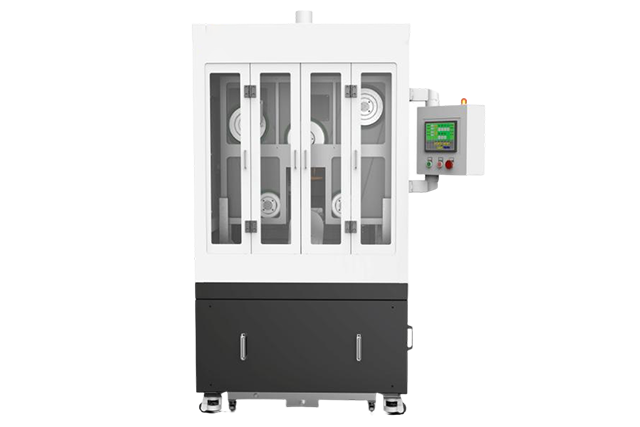
1. What Is a Multi Wire Saw?
Simply put, a multi wire saw is a cutting machine that uses more than one wire.
Each wire slices through the workpiece. As a result, multiple slices can be produced in one cutting cycle.
Multi wire saws work best in high-production applications. These machines are commonly used for:
- Silicon wafer production
- Photovoltaic wafer production
- SiC wafer production
- Sapphire substrate production
- High-volume ceramic cutting
- Crystal slicing
These days, most multi wire saws utilize diamond wire. As the wire moves, it removes material from the workpiece.
During cutting, the machine maintains wire tension, speed, feed rate, wire spacing, and more.
As a result, manufacturers can repeat the same cutting process time after time.
Multi wire technology can help boost productivity for semiconductor production applications.
2. What Is a Single Wire Saw?
A single wire saw processes wafers with only one cutting wire.
In some machines, the wire moves continuously. In others, it reciprocates back and forth.
Meanwhile, the workpiece travels in the opposite direction.
One workpiece passes through the cutting wire during each cutting cycle. As a result, only one cutting path is created at a time.
Single wire saws are ideal for many different applications. They provide users with flexibility when it comes to material types and workpiece geometry. These machines are commonly used for:
- Research
- Development
- Prototyping
- Small batches
- Precision cutting of various materials
- Crystal cutting
- Cutting ceramics
- Sapphire cutting
- Silicon cutting
- Specialized component processing
Single wire sawing can be done manually or automatically. As a result, there are machines to suit nearly any production requirement.
3. Multi Wire Saw vs Single Wire Saw
The most obvious difference between a multi wire saw vs single wire saw is the number of wires.
Multi wire saws use multiple parallel wires. Conversely, single wire saws only have one wire.
As a result, each machine offers different production capabilities.
Feature | Multi Wire Saw | Single Wire Saw |
Cutting wires | Multiple | One |
Simultaneous cutting | Yes | No |
Production capacity | High | Low to moderate |
Cutting flexibility | High | Very high |
High-volume production | Excellent | Limited |
Small-batch production | Suitable | Excellent |
Silicon wafer production | Excellent | Suitable |
Research applications | Suitable | Excellent |
Automation | Usually high | Manual or automatic |
Process adjustment | Moderate | Very flexible |
Material utilization | High | High |
Equipment complexity | Higher | Lower |
Best application | Mass production | Flexible precision cutting |
Simply put, there is no better choice in all scenarios. Production volume, material, workpiece size, and process details will dictate the best equipment for your application.
4. How Does a Multi Wire Saw Work?
Multi wire saws create several parallel cutting lines. These wires are spaced evenly apart by the machine.
Operators mount the workpiece into the multi wire saw. The machine then creates the array of wires. A tension system then applies force to these wires. Once everything is set, the wires can start moving. A feed system simultaneously moves the workpiece through the moving wires.
Particles affixed to the wires cut away material. As a result, multiple slices are created at the same time.
Cooling fluid clears away heat and debris. In the background, the control system monitors the cutting process. Once the preset cutting cycle is complete, the machine stops cutting.
5. How Does a Single Wire Saw Work?
Single wire saws utilize only one wire to cut material.
The machine pushes the wire across the workpiece. At the same time, the workpiece moves through the cutting zone.
Particles affixed to the wire will scrape away material.
Only one cutting path will be created with each cutting cycle.
Operators can adjust wire tension, wire speed, feed rate, cutting depth, workpiece position, and cutting direction.
Since there are so many variables to adjust, single wire machines are very flexible.
6. Cutting Efficiency Comparison
A multi wire saw can make many cuts at once.
As a result, one machine cycle will create many slices or wafer sections.
By comparison, a single wire saw can only create one cut at a time.
If you wanted to cut 100 silicon wafers, a single wire machine would take 100x longer.
MULTI WIRE SAW VS SINGLE WIRE SAW
Multi wire saw = higher cutting efficiency
Single wire saw = greater process flexibility
When it comes to producing high volumes of silicon wafers, multi wire technology is usually the better choice.
7. Production Capacity Comparison
Production capacity increases with the number of simultaneous cutting paths.
For example, a multi wire saw can produce many slices per cycle.
Once completed, the machine quickly begins the next cutting cycle.
This ability is especially useful when working with large silicon ingots. Rather than slicing each wafer individually, a multi wire saw cuts through multiple sections at once.
Single wire machines only create one slice at a time.
Therefore, their total throughput is typically lower.
Single wire machines are perfectly adequate for research, prototyping, and low-volume production. They can also be used with specialty materials and non-uniform component sizes.
The volume of your production run should be a major consideration when choosing between these two saw types.
8. Cutting Precision Comparison
Precision cutting is possible with both types of equipment. However, the achievable precision can vary.
Machine design and process control are important factors for both systems.
For example, a multi wire saw needs to account for multiple wires.
Wire tension and spacing are two details that need precise control.
In addition to these concerns, the machine must maintain:
- Wire alignment
- Constant wire tension
- Proper wire spacing
- Accurate feed
- Rigidity
By comparison, single wire saws only have one wire to control. Operators can focus entirely on a single cutting path.
Single wire machines are often more flexible when it comes to specialized cutting jobs.
That being said, a high-quality multi wire machine can achieve exceptional levels of consistency as well.
Potential customers should compare actual machine specs instead of assuming one machine is more precise than another.
9. Material Loss and Kerf Comparison
Kerf refers to the amount of material lost during cutting.
Multi wire and single wire machines can use thin diamond wire. For this reason, both machines are capable of producing low kerf loss.
However, wire diameter is still an important consideration.
Thinner wire creates a thinner slice path.
As a result, manufacturers can greatly increase material utilization.
Material is often expensive when it comes to semiconductor production. Silicon and SiC are no exceptions.
Smaller wire diameter → narrower kerf → less material loss
Thin wire requires more precise tension control. Therefore, there is always a tradeoff to consider.
10. Automation Comparison
Multi wire saws typically require full automation.
After all, the machine must control each individual wire. Automated functionality allows the machine to control:
- Wire tension
- Wire speed
- Wire spacing
- Feed
- Cooling
- Cutting cycles
- Safety parameters
Single wire saws can be automated or manually controlled.
Manual control is possible because there is only one wire to control.
Single wire machines are more flexible when it comes to operation methods.
However, automated multi wire systems offer the highest productivity levels for large production lines.
11. Application Comparison
Let’s review the types of applications each machine is commonly used for:
Multi Wire Saw Applications
Multi wire saws are ideal for high-production applications, such as:
- Silicon wafer production
- Photovoltaic wafer production
- SiC wafer production
- Sapphire substrate production
- High-volume ceramic cutting
- Crystal slicing
Applications that require large amounts of repetitive cutting benefit from multi wire technology.
Single Wire Saw Applications
Single wire saws are ideal for:
- Research
- Development
- Prototyping
- Small batches
- Irregular workpieces
- Specialized material processing
- Precision sample cutting
When cutting non-standard parts or only small quantities, single wire saws make much more sense.
12. Multi Wire Saw for Silicon Wafer Manufacturing
Silicon wafer manufacturing is one of the strongest applications for multi wire machines.
Manufacturers start with a silicon ingot.
The multi wire saw slices the ingot into wafer sections.
Since there are multiple wires operating, many wafers can be created during one cutting cycle.
However, the process must also be precise.
Parameters like wire diameter, wire spacing, wire tension, wire speed, feed rate, cooling flow, and ingot alignment can affect…
- Wafer thickness
- Kerf loss
- Cutting consistency
After cutting, wafers will typically be ground, polished, cleaned, and inspected.
Therefore, multi wire sawing can be considered an upstream process.
Nanjing Top Wafer offers multi- wire cutting equipment for silicon and other advanced materials.
Its MW2318 model supports monocrystalline silicon and polycrystalline silicon production.
The machine can also process SiC, glass, ceramics, and more materials.
13. Single Wire Saw for Precision Cutting
Single wire machines provide excellent flexibility during processing.
As the name implies, there is only one cutting wire on the machine.
Operators can easily change the cutting path when using a single wire.
This is ideal for small or unusually-shaped workpieces.
Single wire saws can also be used for research and development purposes.
A researcher may need to test many different materials or change cutting parameters regularly.
Flexibility becomes important during these types of workflows.
The single wire saw solutions from Nanjing Top Wafer offer manual or automatic configurations.
Automatic features can include PLC control, automatic tensioning, and motor-driven feed.
Nanjing Top Wafer Single Wire Saw
Operators who need flexible research capabilities or specialized production applications can consider single wire systems.
14. Multi Wire Saw vs Single Wire Saw for SiC
Silicon carbide requires specialized cutting technology.
SiC is known for high hardness. As a result, diamond abrasive is commonly used.
Both multi wire and single wire systems are suitable for SiC.
However, their use cases are slightly different.
- High-volume SiC wafer production → Multi Wire Saw
- Research or custom SiC cutting → Single Wire Saw
Nanojing Top Wafer lists several SiC cutting applications from 2″ wafers up to 8″.
Wire diameter can range from 0.06 mm to 0.15 mm on listed SiC configurations.
Listed TTV specification can be ≤10 μm for certain models.
Which machine you should choose depends on your production goals.
15. Multi Wire Saw vs Single Wire Saw for Sapphire
Sapphire is known for high hardness and optical qualities.
As a result, it also requires the right abrasive cutting technology.
Diamond wire offers effective cutting capabilities.
Multiple slices of sapphire can be processed simultaneously with a multi wire saw.
Therefore, the multi wire option is better for mass production.
Single wire saws are more flexible.
This flexibility can benefit research, prototypes, and small sapphire parts.
Nanjing Top Wafer lists cutting applications for 2″ up to 6″ sapphire materials.
Supported wire diameters range from 0.08 mm up to 0.18 mm.
Both multi wire and single wire technology can be suitable for sapphire cutting.
16. Cost Considerations
The equipment cost is another key difference to consider.
Multi wire saws typically have more complex mechanics and control systems.
As a result, initial equipment costs are usually higher.
Examples include:
- Multiple wire systems
- Advanced tension control
- Precision wire guides
- Automated feeding systems
- Advanced control software
- Necessary cooling / filtration
However, higher throughput can lead to a lower cost per finished wafer.
Decide based on total production costs instead of equipment price alone.
Single wire saws are typically more basic in design.
As a result, initial investment is usually lower than a multi wire saw.
Single wire machines are also more suitable for small production jobs.
Which is best? It all depends on your production model.
- For high-volume production
A multi wire saw may cost less money long-term.
- For low-volume or small-batch production
A single wire saw may have a lower cost of entry.
Don’t look at machine cost without considering your production volume.
17. Which Wire Saw Should You Choose?
There is no one-size fits-all answer to this question.
However, you can choose the right technology by considering your production needs.
Choose a Multi Wire Saw If:
- You produce wafers in large quantities.
- You need high production capacity.
- You’re processing silicon ingots.
- You want simultaneous cutting.
- You want to minimize cutting time.
- You need a fully automated production process.
- You process SiC wafers on a large scale.
- You want consistent thickness for each wafer.
Simply put: Multi wire technology excels at industrial mass production.
Choose a Single Wire Saw If:
- You work with small batches.
- You are doing research and development.
- You have irregular workpieces.
- You need to change cutting parameters very often.
- You want freedom to adjust the cutting path.
- You need to produce customized components.
- You value flexibility over throughput.
Simply put: Single wire technology excels at specialized processing.
18. Nanjing Top Wafer Wire Saw Equipment
Nanjing Top Wafer Precision Equipment Co., Ltd. specializes in semiconductor wafer processing equipment.
The company specializes in both multi wire and single wire saw equipment.
Therefore, customers have multiple cutting technology options.
Multi Wire Saw
Nanojing Top Wafer offers multi wire cutting machines for:
- Monocrystalline silicon
- Polycrystalline silicon
- SiC
- Sapphire
- Glass
- Ceramics
- Crystals
The MW2318 model supports wire diameter as small as 0.04 mm up to 0.25 mm.
Wire speed can reach 3,000 m/ min. The maximum workpiece size is around 230 × 250 × 180 mm.
Single Wire Saw
Single wire machine solutions are available in manual or automatic configurations.
Automatic machines can include PLC control, automatic tensioning, and motor-driven feed.
Customers should choose the configuration that meets their production volume and process needs.
Nanjing Top Wafer Wire Saw Machines
For those wondering “what’s the difference between a multi wire saw and single wire saw?” consider your production volume and need for process flexibility before buying equipment.
Home
19. Frequently Asked Questions
l Which wire saw is better for silicon wafer manufacturing?
Multi wire saws are usually better for silicon wafer manufacturing at high volumes.
They create multiple sections during one cutting cycle.
→ Faster Production Rate
l Can a single wire saw cut silicon?
Both multi wire saws and single wire saws can cut silicon.
For high-volume wafer manufacturing, a multi wire saw has strong advantages.
l What is the difference between multi wire saw and single wire saw machines?
Multi wire machines use multiple parallel wires.
Single wire machines use one wire.
→ Multi wire machines typically have a higher production capacity.
l Which wire saw cuts faster?
A multi wire saw cuts faster since there are multiple wires operating simultaneously.
l Can you use a single wire saw for sapphire?
Diamond wire can cut sapphire with any of the above machines.
A multi wire saw is better for larger production volumes.
A single wire saw is better for smaller or specialty applications.
l Do multi wire saws use less wire?
Both single wire and multi wire machines can use thin diamond wire.
As a result, both machines can provide low kerf loss.
l Which is more accurate: a multi wire saw or single wire saw?
Both machines can achieve strong accuracy levels.
The machine design, control system, wire condition, and process parameters affect cutting accuracy.
l Which wire saw has less kerf?
Both types of wire saw can have thin wire.
→ Both can have low kerf loss.
l Which wire saw is better for research?
A single wire saw is usually better for research and prototype production.
A single wire saw is more flexible.
l Which wire saw cuts with less vibration?
Since single wire saws only have one wire, there is less vibration during cutting.
However, both can achieve strong cutting stability with the right machine configuration.
l Is a multi wire saw automated?
Multi wire saws typically require more automation.
The machine must control and coordinate multiple wires.
Automated tension and positioning becomes critical.
l Which wire saw should I buy?
First, ask yourself how much you need to produce.
Next, consider material type, workpiece size, wafer thickness, cutting accuracy, degree of automation, and budget.
If you want to mass-produce wafers, buy a multi wire saw.
If you need flexible technology for small-batch production, buy a single wire saw.
20. Conclusion
When comparing a multi wire saw vs single wire saw, there are two things to consider:
Production efficiency vs process flexibility.
Multi wire saws use multiple wires to create many cuts at once.
Single wire saws use only one wire. Cutting must be done one path at a time.
→ Single wire machines allow for more flexible cutting paths.
Both can process silicon wafers, SiC, sapphire, ceramics, glass, and more.
Materials alone shouldn’t determine what machine you purchase.
Also consider production volume, specifications, required automation, and whether you need process flexibility.