
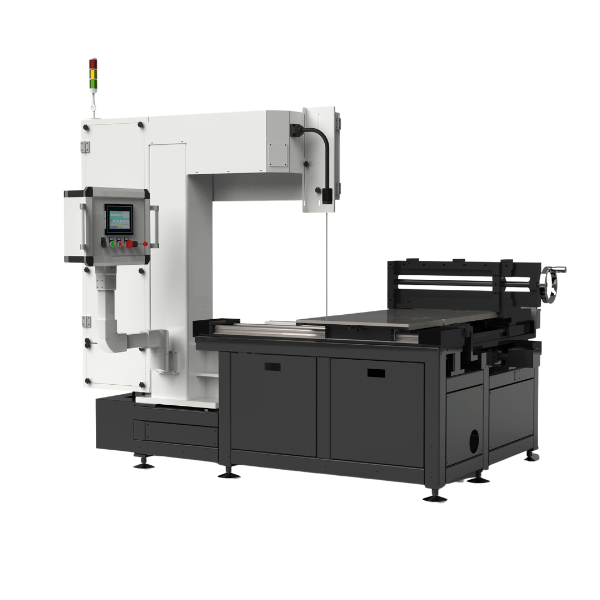
1. What Is a Multi Wire Saw for Silicon Wafer Manufacturing?
This specialized cutting machine uses several parallel wires to cut silicon ingots.
Silicon wafer manufacturing: One machine can create multiple cutting paths simultaneously.
Producing more than one wafer section per cutting cycle becomes possible.
Diamond wire is common in today’s multi wire saw machines.
Diam
ond abrasive provides the cutting action while the machine controls variables such as wire tension, wire speed, feed rate and wire spacing.
Controlled and repeatable silicon cutting becomes possible.
Manufacturers use many different processes to produce finished silicon wafers.
These stages typically include:
- Silicon crystal growth
- Silicon ingot processing
- Ingot cropping
- Orientation and alignment
- Multi-wire slicing
- Wafer grinding
- Wafer polishing
- Cleaning
- Inspection
Multi-wire sawing falls between silicon ingot processing and wafer polishing/grinding.
Consequently, its performance affects everything else.
If the slicing process is repeatable and stable, the wafer manufacturer can often reduce material loss and improve overall wafer consistency.
2. Why Multi Wire Saws Are Important for Silicon Wafers
Silicon wafer manufacturers need to maintain high production efficiency.
Precision is also extremely important. Wafer dimensions must be exact.
The silicon wafer cutting machine needs to balance these often conflicting goals.
Using a multi wire saw helps manufacturers do just that.
Rather than cutting one slice at a time, a multi wire saw cuts multiple slices simultaneously.
Multiple wires work together to create several parallel cutting paths.
Several advantages come from this process.
Higher Production Capacity
Instead of just one wire cutting silicon, several do the job at once.
Consequently, manufacturers can produce more wafer sections in each slicing cycle.
Lower Material Loss
Thin diamond wire allows for a small cutting kerf.
Less silicon goes to waste during the slicing process.
Consistent Wafer Thickness
Controlled wire spacing determines slice thickness.
By precisely controlling this distance, the machine produces consistent wafers every time.
Automated Process Control
Today’s machines can control many important parameters automatically.
Tension, speed, feed rate, and even wire position are examples of these parameters.
Consequently, the entire cutting process becomes more repeatable with fewer errors.
Suitable for High Volume Manufacturing
Producing large quantities of wafers is often necessary for semiconductor and PV manufacturing.
Multi wire saw technology is ideal for these high volume production settings.
3. How Does a Multi Wire Saw Work?
The slicing head of a multi wire saw contains multiple parallel wires.
The wires run through the silicon ingot as it gets fed through the machine.
Diamond abrasive cuts the silicon leaving behind perfectly sectioned wafers.
This is a basic explanation of how multiple wires can cut silicon simultaneously.
Here is a more detailed overview of the multi wire silicon sawing process.
Mount the silicon ingot securely inside the machine.
Establish the cutting wire array.
Apply controlled tension to the wires.
Begin wire movement either by machine or manually.
Slowly feed the silicon into the cutting zone.
Abrasive diamond particles catch onto and remove silicon material from the ingot.
Cooling fluid flows through the entire system to remove heat and debris.
The cutting process is monitored and controlled by the machine.
Complete the cutting cycle and remove the finished silicon wafers.
Once finished, wafers can go through further processing steps.
Essentially, multi wire sawing is responsible for the slicing step in silicon wafer manufacturing.
4. Silicon Wafer Manufacturing Process
Before discussing multi wire saws in more detail, it helps to understand the entire silicon wafer process.
4.1 Silicon Crystal Growth
The process begins with silicon crystal growth.
Silicon crystals form the base material for wafer production.
4.2 Ingot Processing
The crystal gets processed into a cylindrical shape known as a silicon ingot.
Further processing takes place to achieve the correct ingot dimensions.
4.3 Ingot Cropping
Sometimes the ingot ends need cropping or cutting.
This step prepares the silicon ingot for wafer slicing.
4.4 Orientation and Alignment
Orientation establishes which direction the crystals cut.
Alignment ensures the correct portion of the silicon ingot enters the multi wire saw.
4.5 Multi Wire Slicing
Finally, the multi wire saw slices up the silicon ingot.
Multiple wires slice through the ingot creating multiple wafer sections at once.
Higher productivity is one of many reasons to use multi wire saw technology.
4.6 Wafer Grinding
Right after slicing, wafers may have surface and thickness variation.
Wafer grinding evens out the geometry of the wafer.
Essentially, grinding creates a flat surface and helps achieve the proper thickness.
4.7 Wafer Polishing
Wafer polishing creates a smooth and uniform finish on the wafer.
4.8 Cleaning
Any remaining debris or processing residuals must be removed from the wafers.
Only then does the wafer become clean enough for further processing.
4.9 Inspection
The last step of wafer preparation involves quality inspection.
Things like thickness, TTV, flatness, surface quality, and visible defects can be measured and recorded.
5. Multi Wire Saw in Silicon Ingot Cutting
Cutting a silicon ingot into thin wafers is an important part of wafer production.
One silicon ingot can create many wafers.
Production throughput and material utilization are heavily affected by how well you slice up the ingot.
Producing multiple simultaneous cutting paths is what makes a multi wire saw so effective.
The distance between each wire determines spacing between wafer slices.
Wire diameter also affects kerf width.
Both spacing and kerf must be considered when trying to maximize material usage.
Wire tension also plays a key role in the slicing process.
Unstable wire tension can cause the wire to change heights while cutting.
This makes for an unstable cutting path and ruined wafers.
Machine rigidity is another important factor.
Excessive machine or slicing head vibration can ruin wafers.
The surface quality and geometry may be damaged by vibration.
For these reasons and more, high quality multi wire saws are precise machines with effective control systems.
6. Diamond Wire for Silicon Wafer Manufacturing
Diamond wire is commonly used in modern silicon wafer slicing equipment.
Diamond wire has tiny diamond abrasive particles exposed along its surface.
These particles grab onto silicon when they contact the material and cut away at it.
Natural diamond is one of the hardest materials on earth.
This hardness allows diamond wire to cut through silicon with relative ease.
Not only is diamond hard, but it can also be drawn into extremely thin wire.
Thin wire creates a smaller kerf which reduces material loss during cutting.
Since producing silicon wafers takes a lot of time and material, reducing loss is very important.
However, the thinner your wire is, the more precise your machine has to be.
Your machine will need to precisely control wire tension, wire speed, feed rate, wire position, and workpiece alignment.
Machine and wire become a system that needs to be finely tuned.
Diamond Wire Saw Machine
7. Multi Wire Saw Cutting Parameters
Everything from wire diameter to coolant flow affects multi wire saw performance.
Below we explain the most important parameters.
Wire Diameter
Cutting wire diameter directly correlates to kerf width.
Smaller diameter wire equals less material loss.
However, the smaller the wire, the more precise your tension control needs to be.
Wire diameter should be chosen based on your entire process.
Wire Speed
Wire speed is how fast the cutting wire travels.
Faster wire speeds equal higher productivity.
However, increased wear and cutting errors can become a problem.
Wire speed should be optimized based on your process parameters.
Wire Tension
Wire tension keeps the wires from moving around while cutting.
Consistent tension allows for a repeatable cutting process.
However, too much tension can increase the chance of wire breakage.
Automation can help monitor and control your wire tension.
Feed Rate
Feed rate is how fast you feed the silicon into the cutting zone.
Like wire speed, faster feed rates equal higher productivity.
However, too much feed will cause excess stress on your wires.
Again, you will need to find a balance that works with your specific application.
Wire Spacing
Wire spacing determines your wafer thickness.
Accurate wire spacing is crucial for keeping good thickness control.
Small wire spacing allows you to create very thin wafers.
However, you’ll need to leave enough material for your grinding process.
Cooling Flow
Enough coolant flow is necessary to keep your cutting zone cool.
It also flushes away cutting debris.
Unstable cooling rates can cause your process to be less consistent.
8. Wafer Thickness and Wire Spacing
The spacing of your wires affects the finished wafer thickness.
Wires in a multi wire saw are arranged parallel to each other.
The space between each wire corresponds to where each wafer will be.
Thus, adjusting wire spacing allows you to customize the thickness of your wafers.
However, cutting loss also contributes to the final wafer thickness.
You also need to take into account:
- Wire diameter
- Kerf width
- Wire spacing
- Cutting parameters
- Allowance for grinding
- Final target wafer thickness
There needs to be enough material left for your wafer grinding process.
So make sure your multi wire saw is set up to work with your entire wafer production process.
9. TTV Control During Silicon Wafer Cutting
TTV stands for Total Thickness Variation.
Thickness variation is measured across the entire surface of a wafer.
TTV is used as an indicator of wafer geometry.
While your multi wire saw doesn’t solely determine wafer TTV.
If you have poor cutting geometry, you’ll need to correct more afterwards.
Wire Tension
Maintaining consistent wire tension helps ensure the wires don’t move around while cutting.
Machine Rigidity
A sturdy machine reduces unwanted movement.
Guide Wheel Accuracy
Guide wheels help keep your wires positioned correctly.
Feed Accuracy
The more precise your feed mechanism is, the more control you have over the cutting depth.
Workpiece Alignment
Proper workpiece alignment ensures you cut the wafer in the correct direction.
Control as many aspects of the cutting process as you can.
Nanjing Top Wafer lists silicon wafer cutting equipment that has TTV ≤5 μm available for certain high-tech models.
Results will vary depending on material used, machine configuration, wire used, and process parameters.
10. Kerf Loss in Silicon Wafer Manufacturing
Kerf loss is the term used to describe lost material after a cutting process.
There is always going to be some material loss when cutting something.
Kerf loss is very important to silicon wafer manufacturers.
Thankfully, you can use thin diamond wire on a multi wire saw.
Thin wire translates into a thinner kerf.
Less material is lost to kerf which improves your silicon utilization.
For high volume silicon wafer manufacturing, kerf loss can start to add up.
However, the thinner your wire is, the more you have to worry about wire stability.
Low kerf loss and wire stability don’t come without costs.
There is typically a tradeoff with productivity and/or cutting quality.
Again, the ideal wire you should use depends on your application.
Tryout different wire specs on your machine to see what works best.
11. Surface Quality After Multi Wire Sawing
Wire sawing gives you the initial wafer surface.
That being said, the surface condition you produce will affect everything down stream.
There are many different things that affect surface quality.
Wire Condition
Wires will begin to wear with use. A worn wire won’t cut the same as a new wire.
Feed Rate
Too high of a feed rate can put unnecessary stress on your cutting process.
Wire Speed
Same concept as feed rate, but for your wire speed.
Machine Vibration
The more vibration your machine has, the more variance you’ll have in your cut.
Cooling
Maintaining a stable cooling rate will prevent your cutting zone from getting too hot.
Once the silicon wafers pass through the multi wire saw, they typically go through grinding and polishing.
Surface finishing doesn’t happen at the multi wire saw stage.
12. Multi Wire Saw Parts
Each multi wire saw system is comprised of various subsystems.
Wire Feed System
This system regulates wire motion.
Wire Array System
This system creates multiple parallel cuts.
Guide Wheels
Guide wheels keep the wires properly aligned.
Tension System
This system applies tension to the wires.
Workpiece Feed System
This system feeds the silicon ingot through the wire array.
Cooling System
The cooling system dissipates heat from the cutting area.
Filtration System
The filtration system cleans cutting fluid of cut silicon particles.
Control System
The control system synchronizes speeds and movement throughout the saw.
13. Benefits of Multi Wire Saw Machines
These machines offer benefits that make them suitable for many silicon wafer production applications.
High-Speed Production
Each wire makes independent cuts. Therefore, operators can generate many wafer slices during each pass.
Thin Kerf Loss
The use of thin diamond wire allows for less loss of silicon.
Consistent Slice Sizes
Keeping wire spacing consistent helps create uniform slices.
Faster Production Time
Since multiple cuts happen at once, total production time may be reduced.
Automation Capabilities
Many modern multi wire saws offer automation features.
Operators can automate tension, feed rate, speed, machine movement, and safety features. Therefore, production consistency increases.
Multi-Material Applications
Not only can multiple wires slice through silicon. Therefore, manufacturers can use them to cut different materials as well.
14. Multi Wire Saw vs Single Wire Saw
Different machines excel at different things.
Yet, they can each cut silicon wafers.
Feature | Multi Wire Saw | Single Wire Saw |
Cutting wires | Multiple | One |
Simultaneous cutting | Yes | No |
Production capacity | High | Moderate |
Silicon wafer production | Excellent | Suitable |
High-volume production | Excellent | Less suitable |
Process flexibility | High | Very high |
Research applications | Suitable | Excellent |
Automation | High | Manual or automatic |
Cutting efficiency | High | Lower |
Multi wire saw machines are typically better for mass production of silicon wafers.
On the other hand, single wire saw machines work better for custom applications.
So, choose the machine that best suits your production needs.
15. Applications of Multi Wire Saws
Multi wire saw machines can be used for many different applications.
Silicon Wafer Production
Fabricating silicon wafers is one of the most common uses for a multi wire saw.
The machines cut large silicon ingots into many smaller wafers.
Therefore, they are used in both the semiconductor industry and photovoltaic production.
SiC Wafer Production
SiC, or silicon carbide, wafers are commonly used in power electronics.
Because of SiC’s hardness, cutting these wafers requires the proper tools.
Therefore, a multi wire saw with diamond wire can cut SiC wafers.
Sapphire Substrate Production
Sapphire wafers are another advanced substrate that requires precision cutting.
Therefore, sapphire substrates can also be cut with a multi wire saw.
Advanced Ceramics
Like sapphire, many advanced ceramics need to be cut with precision.
Therefore, manufacturers can use multi wire saws to create ceramics wafers.
Glass and Crystal Cutting
Similarly, glass and crystals can also be cut with a multi wire machine.
Therefore, these machines are not limited to semiconductor wafers.
16. Buying a Multi Wire Saw
When trying to decide which multi wire saw to purchase, consider the following:
1. Wafer Size
First, you need to know what size wafer you want to produce.
Some common semiconductor wafer sizes are:
- 2-inch
- 4-inch
- 6-inch
- 8-inch
- 12-inch
The machine you choose must be able to cut the size ingot required to create these wafers.
2. Production Amount
If you plan on doing a lot of production, you’ll likely need a multi wire saw.
That’s because most single wire saws lack the production capabilities of multi wire systems.
3. Wafer Thickness
Then, you’ll need to know how thick you want your wafers to be.
After choosing your target wafer thickness, you should calculate what wire spacing and grinding allowance will work best.
4. Wire Size
Look at what size wire the machine can use.
Also consider the max and min allowed wire tension and speed.
Once you have this information, you’ll be able to see if the machine will work with your process.
5. TTV
What is your TTV spec? (TTV stands for Total Thickness Variation)
Once you know this, check to see if the machine can meet your placement specs.
6. Cooling & Filtration
Don’t forget about cooling capabilities.
A stable source of cooling allows for longer production times.
Look for a machine with a reliable fluid circulation system and filtration system.
7. Want automation?
Automated tension, automatic feed rates, and automated parameter calibration ensures consistent cuts every time.
If your going for high volume production, you’ll want as much automation as possible.
8. Technical Support
Make sure the machine brand you choose can support you before buying.
They should offer installation and commission services.
The company should also be able to help you with your process and train you on how to use the machine.
17. Nanjing Top Wafer Multi Wire Saw Machines
Nanjing Top Wafer Precision Equipment Co., Ltd. is a Chinese wafer processing equipment supplier that focuses on semiconductor wafer processing equipment.
MW2318 Multi Wire Cutting Machine Model
Materials The machine is suitable for processing monocrystalline silicon, polycrystalline silicon, SiC, ceramics, glass, crystal
and other advanced material substrate materials.
The company offers multi wire saw machines and other wafer cutting and processing machinery.
Machine measurements are roughly 230 × 250 × 180 mm.
NanoTopWafer’s multi wire saw machines can process:
Max workpiece size. 230250180 (mm)
Wire diameter. 0.04-0.25 (mm)
Wire speed. ≤3000 (m/ min)
Advantages The machine supports wire diameters ranging from 0.04mm up to 0.25mm.
NanoTopWafer also manufactures other high precision wafer cutting machines.
NanoTopWafer has high tech wafer cutting solutions for silicon wafer sizes ranging from 2-inch all the way up to 12-inch.
This means you can change machine configurations to fit your material and production needs.
18. Multi Wire Saw Maintenance
Regular maintenance helps maintain cutting accuracy and production stability.
First, inspect the cutting wire.
Next, check guide wheels for wear.
Then, verify wire tension.
Operators should also inspect bearings and linear guides.
Furthermore, check the cooling system.
The filtration system should receive regular maintenance.
Operators should also monitor cutting fluid quality.
Then, inspect pumps and circulation components.
Machine alignment should receive periodic inspection.
Finally, monitor wafer quality during production.
Changes in wafer thickness or surface condition can indicate machine problems.
Therefore, preventive maintenance should combine equipment inspection and process monitoring.
Home
19. Multi Wire Saw FAQ
l What does a multi wire saw do?
A multi wire saw is used to cut silicon wafers. A multi wire saw can make multiple cuts at once.
l Why would someone use a multi wire saw for silicon wafers?
Using a multi wire saw reduces cutting time. Therefore allowing for more wafers to be cut at one time.
They can cut multiple slices of silicon at once.
Can decrease kerf loss by using thinner diamond wire.
l What is the process of a multi wire saw?
A multi wire saw pushes multiple wires with an abrasive across the surface of a silicon ingot.
Diamond will then cut the silicon as the feed system moves the silicon through the wires.
l What type of wire is used to cut silicon wafers?
Diamond wire is used to cut silicon wafers.
Why? Because diamond is hard enough to cut through silicon.
l Can multi wire saws cut 12 inch silicon wafers?
If the machine has the capacity to cut a 12 inch by however many inch thick ingot, then yes.
NanoTopWafer lists their silicon wafer cutting capabilities as ranging from 2″ all the way up to 12 inches.
l What is kerf loss?
Kerf loss is thickness of material removed by the wire.
Typically the thinner the wire the less kerf loss.
l What is TTV for silicon wafers?
TTV stands for Total Thickness Variation.
It is used to measure the variation in thickness of a wafer.
l Does the multi wire saw determine the thickness of the silicon wafer?
Not exactly.
l What happens after you finish cutting your wafers with a multi wire saw?
Generally speaking, wafers will go through a grinding process.
After they are ground they will be polished and cleaned before final inspection.
Do you know what comes before the grinding process? Yeah, cutting your wafers.
l How do you minimize silicon loss?
By reducing the diameter of the wire. You can also reduce the space in between each wire.
Manufacturers can reduce silicon loss by carefully managing and improving their process.
l What should I look for in a multi wire saw?
Hopefully we answered that. If not let us know in the comments below!
To find out if a machine is right for your particular process, consider running a cutting test.
20. Conclusion
Multi wire saw machines for silicon wafers are machines that use multiple wires to cut silicon ingots into wafer sizes.
They allow for multiple cuts to be made at once.
Diamond wire is often used to cut through silicon ingots.
As the distance between wires can determine how thick the wafer will be after it’s cut.
If the wire is not tight enough, or if the feed speed is off.
You’ll want to take these things into consideration when buying your multi wire saw.
NanoTopWafer is a company that sells multi wire saw machines and other semiconductor wafer processing machinery.
They have machines that can cut many different types of materials.
If your looking for a Multi Wire saw for silicon wafer production, Nanjing Top Wafer has you covered.