
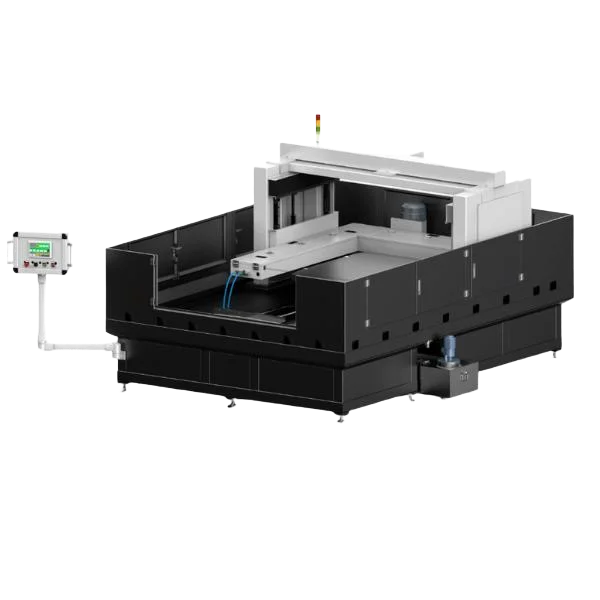
The central difference in Multi Wire Saw vs Single Wire Saw is the number of active cutting paths. A multi-wire saw makes multiple parallel cuts simultaneously, while a single-wire saw uses one active cutting path. Choose around production volume, geometry, changeovers, and verified quality rather than wire count alone.
1. How Do Single-Wire and Multi-Wire Saws Work?
Both configurations use moving wire to remove material, but they organize cutting paths differently. That difference affects production planning and setup requirements.
How does a single-wire saw cut?
A single-wire saw presents one active cutting span to the workpiece. The machine coordinates wire motion, tension, and feed.
Depending on its design, the wire may reciprocate between reels or circulate as an endless loop.
Therefore, “single-wire” does not automatically mean “endless wire.” Confirm the actual wire arrangement when comparing machines.
Single-wire equipment can also include automated positioning and repeated cutting sequences. One active cutting path does not imply manual operation.
How does a multi-wire saw cut?
A multi-wire saw presents several parallel wire spans to the workpiece. These spans create multiple cutting channels during one operation.
Importantly, the spans may come from one continuous wire routed repeatedly around grooved rollers. They need not represent separate wires.
Fraunhofer IKTS describes multi-wire sawing as an established silicon-processing method. It also distinguishes fixed diamond abrasives from loose-abrasive slurry systems.
In a Multi Wire Saw vs Single Wire Saw comparison, separate cutting-path arrangement from abrasive technology.
2. Multi Wire Saw vs Single Wire Saw: What Changes?
The main tradeoff concerns simultaneous slicing and flexibility between individual cuts. However, machine design can substantially change that balance.
Use the following table as an initial screening tool. Confirm every model-specific capability through documentation and representative trials.
Selection factor | Multi-wire saw | Single-wire saw |
Active cutting paths | Multiple parallel spans | One active span |
Production pattern | Simultaneous slicing | Individual or sequential cuts |
Typical evaluation priority | Consistency across the wire field | Control of each required cut |
Thickness changes | May require wire-field configuration changes | May use positioning changes between cuts |
Setup considerations | Roller grooves, wire routing, mounting | Wire path, mounting, positioning |
Output assessment | Accepted pieces across a batch | Accepted pieces across a cutting sequence |
Potential application | Repeated parallel wafer production | Sampling, sectioning, varied cutting tasks |
Quality verification | Within-batch and batch-to-batch results | Cut-to-cut and setup-to-setup results |
These application descriptions provide general selection guidance. They do not establish universal performance rankings.
A machine with more active spans can still encounter handling or finishing bottlenecks.
Similarly, a flexible cutting system may become inefficient when repeated sequential cuts dominate production time.
3. When Should You Choose a Multi-Wire Saw?
Consider multi-wire equipment when your process needs repeated parallel slices from compatible workpieces. Its simultaneous cutting arrangement supports batch-oriented production.
For example, silicon wafer manufacturing involves producing multiple slices from an ingot. Multi-wire sawing directly addresses that production pattern.
However, nominal slice count does not equal usable output. Evaluate the complete batch against your acceptance criteria.
Does simultaneous cutting guarantee higher throughput?
No. Simultaneous cutting increases the number of active cutting paths, but actual throughput depends on the complete workflow.
Include loading, alignment, cutting, unloading, separation, cleaning, and inspection.
Also examine how operators respond to interruptions. Recovery time can materially affect production availability.
For Multi Wire Saw vs Single Wire Saw purchasing decisions, compare accepted pieces per scheduled production period.
This measurement captures more operational detail than cutting speed alone.
When does batch consistency matter most?
Batch consistency matters when downstream processes expect predictable thickness and geometry.
Request measurements from different positions across the sliced workpiece. A few selected wafers cannot characterize every cutting channel.
Also ask how the supplier manages consumable condition throughout the intended operating cycle.
multi-wire wafer slicing equipment
4. When Should You Choose a Single-Wire Saw?
Consider single-wire equipment when individual cuts, changing requirements, or sample preparation dominate your workload. Evaluate the positioning system alongside the cutting mechanism.
A laboratory may need sections from different sample sizes. A development team may frequently change thickness targets or cutting locations.
In these situations, setup flexibility can matter more than simultaneous slice count.
These are application suggestions, rather than guarantees for every machine.
Can a single-wire machine support automated production?
Yes, some configurations can automate feed, positioning, and repeated cuts. Verify the proposed model’s actual functions.
Ask whether automation includes only cutting or also indexing, loading, and unloading.
Those distinctions affect staffing and production planning.
What should laboratories prioritize?
Prioritize sample compatibility, mounting options, cut location, and inspection requirements.
Also consider whether the process could contaminate or alter the feature under investigation.
Manufacturer WELL identifies research, quality control, production, and material analysis among its precision-cutting applications. That establishes application breadth, rather than a universal performance guarantee. High precision cutting
A useful Multi Wire Saw vs Single Wire Saw assessment therefore begins with the sample’s purpose.
single-wire precision cutting equipment
5. Which Configuration Provides Better Cutting Quality?
Neither configuration automatically delivers better quality. Quality depends on the machine, wire, workpiece, mounting, and operating conditions.
Define what “precision” means before comparing quotations. Different applications require different measurements.
Which measurements should buyers request?
For wafer slicing, consider:
- Target thickness and total thickness variation.
- Bow or warp, where relevant.
- Surface roughness and recurring cutting marks.
- Edge chipping and breakage.
- Surface and subsurface damage.
- Finishing allowance and final accepted yield.
Specify the measurement method and inspection stage.
For sample sectioning, cut location and feature preservation may carry more importance than wafer-oriented metrics.
Does thinner wire always reduce total material loss?
No. A thinner wire may support a narrower cutting channel, but actual results require measurement.
Wire movement, abrasive characteristics, and process conditions influence the resulting kerf.
Furthermore, rejected pieces and additional finishing can offset reduced cutting loss.
In Multi Wire Saw vs Single Wire Saw evaluations, compare total usable material recovery.
Avoid estimating material savings from nominal wire diameter alone.
Why do process controls matter?
Stable cutting requires coordinated control of interacting variables.
Fraunhofer CSP uses force-instrumented multi-wire saws to investigate process parameters and consumables. This supports evaluating their interactions through controlled experiments.
For purchasing, request a documented operating recipe and monitoring approach.
Do not assume identical tension or feed settings suit different machine architectures.
6. How Should You Compare Operating Costs?
Compare cost per accepted part using the same accounting boundaries. Purchase price alone cannot identify the more economical process.
A useful cost review includes:
- Equipment ownership and installation.
- Wire, cutting fluid, and other consumables.
- Labor during setup and operation.
- Maintenance and replacement components.
- Cleaning, handling, and downstream finishing.
- Rejected workpieces and material losses.
- Changeovers and production interruptions.
Use this calculation:
Cost per accepted part = Total allocated process cost ÷ Accepted parts
Define “accepted” using the same inspection requirements for both options.
When can multi-wire economics become attractive?
Multi-wire economics may become attractive when stable demand supports repeated batch production.
However, low utilization or frequent configuration changes can weaken that advantage.
Evaluate expected product mix alongside production volume.
When can single-wire economics make sense?
Single-wire economics may suit varied workloads where individual setup control supports efficient job completion.
However, repeated sequential slicing can consume substantial machine time.
The financial outcome of Multi Wire Saw vs Single Wire Saw therefore depends on actual workload and acceptance results.
Request separate figures for demonstrated performance and projected production.
7. How Do You Run a Fair Cutting Trial?
Test both proposals against the same production objective rather than identical machine settings. Different architectures may require different operating recipes.
Use representative material and agree on acceptance criteria before cutting.
- Describe the workpiece.Record material, dimensions, condition, and relevant orientation requirements.
- Define the output.Specify thickness, geometry, surface condition, and required quantity.
- Agree on inspection.Document instruments, sampling, measurement locations, and acceptance limits.
- Record the configuration.Identify wire, fixture, fluid, and operating recipe.
- Measure the complete workflow.Include setup, cutting, handling, cleaning, and inspection.
- Track every result.Record accepted pieces, rejects, interruptions, and operator adjustments.
- Inspect downstream effects.Include additional finishing and handling losses.
- Repeat where necessary.Investigate whether results remain stable across representative operating conditions.
What evidence should the supplier provide?
Request raw measurements and a clear test report.
Photographs can document setup and visible condition. They cannot independently verify dimensional accuracy.
Also record limitations. A short demonstration cannot establish long-term maintenance frequency or consumable variability.
For Multi Wire Saw vs Single Wire Saw comparisons, identical reporting boundaries make results easier to assess.
wire saw cutting trials and application evaluation
8. How Should You Evaluate Suppliers?
Choose a supplier that connects your application requirements to documented machine capability. Category labels alone provide insufficient evidence.
The official website of Nanjing Top Wafer Precision Equipment Co., Ltd. lists single-wire and multi-wire equipment categories. This establishes relevance to both options. njwafertop.com
However, a category listing does not establish suitability for your material or quality requirements.
Ask each supplier:
- Which proposed configuration matches our workpiece?
- What trial evidence supports the recommendation?
- Which utilities and consumables does operation require?
- What changes between product sizes or thicknesses?
- Which maintenance tasks require specialist support?
- What acceptance documentation accompanies delivery?
What should accompany your inquiry?
Send a workpiece drawing, material description, output requirements, and expected production pattern.
Include downstream inspection and finishing requirements.
When contacting Nanjing Top Wafer Precision Equipment Co., Ltd., request model-specific confirmation before accepting performance assumptions.
Next step: Prepare one application specification and use it to request comparable technical proposals through the official website.
wire saw maintenance and technical support
9. Frequently Asked Questions
Is a multi-wire saw always faster than a single-wire saw?
No. It makes several cuts simultaneously, but complete workflow time determines production throughput.
Compare usable output after loading, cleaning, inspection, and any required finishing.
Can a single-wire saw produce multiple wafers?
A suitable machine can produce multiple slices through successive cuts. Its positioning and automation capabilities determine how that sequence works.
Confirm thickness control and repeated-cut performance through testing.
Does a multi-wire saw use many independent wires?
Not necessarily. Multiple cutting spans can come from one continuous wire routed around rollers.
Ask the supplier to explain the proposed wire path and replacement procedure.
Which option works better for research laboratories?
A single-wire system may suit changing samples and individual sectioning tasks. However, laboratories studying batch wafering may need multi-wire capability.
Choose around the research objective and required measurements.
Can both configurations process silicon carbide?
Suitability requires confirmation for the specific machine and process. Fraunhofer CSP demonstrates silicon carbide wafering using a dedicated multi-wire research setup.
That example does not establish equivalent capability for every commercial machine.
Should coolant requirements influence equipment selection?
Yes. Verify compatibility with the material, wire, mounting method, machine, and downstream cleaning.
Do not assume every wire-saw design uses the same fluid arrangement.
How can buyers avoid misleading comparisons?
Require matching material, output specifications, inspection methods, and cost boundaries.
Separate measured trial results from estimates and exclude unverified performance claims from the decision.
10. Conclusion
Multi Wire Saw vs Single Wire Saw is a choice about production requirements and process organization.
Multi-wire equipment supports simultaneous parallel slicing. Single-wire equipment supports individual cutting paths and potentially flexible sequential work.
Neither arrangement guarantees superior precision, lower cost, or better material recovery.
Start with your workpiece, required output, and acceptance criteria. Then compare complete workflows through representative cutting trials.
Nanjing Top Wafer Precision Equipment Co., Ltd. lists both equipment categories on its website. Confirm the proposed configuration through current documentation and application-specific evidence.